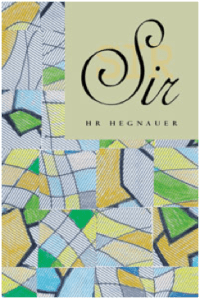
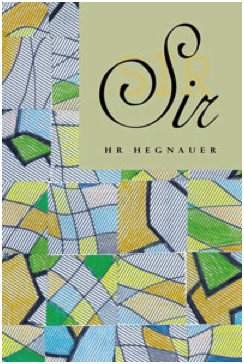
 In her book Sir, HR Hegnauer writes with quiet, stirring, and at times hilarious power about her grandfather (Sir) and her grandmother (Mrs. Alice). Her rich glimpses of the past reveal how her grandparents formed and informed her childhood and young adulthood.
Sir is about human connection and disconnection, about bodies and gender, and, largely, about memory—its ability and its fallibility.
On page nine, Hegnauer writes about war:
I learned about war for the first time in the first grade. We had just started fighting in the Persian Gulf. Mrs. Thom said that we wouldn’t hear any bombs, but that they were real, and they were dangerous — more dangerous than anything we’d ever hope to know. I remember her telling me that we had never lost a war before, and that this was something to be proud of. When I walked home from school that day, Matt told me that not only had we never lost, but that we had never actually been to war until now. I told Sir that we had never been to war before, and now we’re in the Gulf, but don’t be afraid because we won’t actually hear any bombs. I told him like I was an expert on the politics of war. He said, then what the hell was I doing in 1944? I said, I don’t know. Maybe it was only a battle and not actually a war. Sir looked at me. I remember this look for sure like he’s looking at me right now.
Writing Prompt: Write about your earliest memory or understanding of war.
Considerations and Suggestions
As Hegnauer does above, include conversation or dialogue between yourself and another child and/or yourself and another adult.
• Include concrete details, accurate or not.
• Infuse doubt.
• As always, experiment with form and point-of-view.
• Write for 20 minutes.
For more about Sir and HR Hegnauer’s writing, click here and here .
Sir
HR Hegnauer
Portable Press @ YoYo Labs
2013, 96 pp., 6″ x 9″
Poetry
$16.00 Paper, 978-0-615-23100-6
Cover illustration by Brenda Iijima


 According to Jewish law and tradition, this year, 5775, is a Shmita or Sabbatical year, when Jewish farmers are supposed to let the land rest. The idea of fallow fields got me thinking about what grows when you don’t actively plant seeds, either physically or metaphorically.
 The Writeous Sisters