A Tip of the Hat

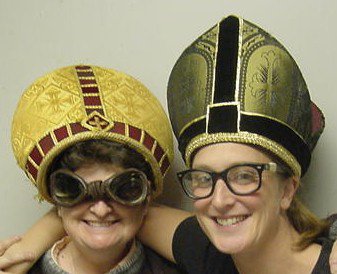
Me and my pal Magic goofing around with hats at the costume shop at the University of Colorado many years ago.

Me and my pal Magic goofing around at the costume shop at the University of Colorado many years ago.

May 28, 2014  Prompt #28

Bonnets, boaters, and bowlers. Berets and beanies. Sombreros. Stetson’s. Stovepipes. Fedoras. Fezzes. Fisherman’s caps. Coal miner helmets. Army helmets. Bike helmets.

Yes, today’s prompt is all about hats.  With their long and rich history, writing about hats can enrich characterization, provoke memories, and, again, ground your writing with specific, sensory details. Hat’s off and let’s go!

Instructions

  1. Choose a hat–yours or someone else’s–for this exercise. While it is best to have a physical hat to hold and feel, you can, alternately, look at headgear on Wikipedia or check out The Hat Blog for inspiration.
  2. Have your hat? For five minutes, write a physical and factual description of  its style, color, and condition. Write briefly about where, when and how you acquired it. If you are looking of a photo of the hat, you can imagine its history .
  3. Next, write the psychological and emotional history of the hat. Do you put it on for practical or stylish reasons? How do you feel wearing it? Do you associate the hat with a person, place, or stage of your life?  Tell your story.

Further Writing

  • Write a poem about your hat. Capture a small slice of time or a specific emotion associated with the hat. Include two or more of these words: mirror, door, sun, eyes, breeze, sturdy, light, other, tilt.
  • Write about trying on the hat of someone who has died.
  • Write about someone who is incomplete without their hat. Tell us how it transforms them.

Variations for Writing Groups

  1. Each member brings one or two hats to writing group. Take turns trying them on and snapping photos of each other with a digital camera. Choose one of the photos as your springboard and write from there.
  2. You are walking on a beach, on a city sidewalk, or in an open meadow. A stiff wind blows a hat your way and it lands two feet in front of you.  What do you do (0r what does your character do?)? Include sensory details, such as texture, temperature, and sounds.

What did you think of this writing prompt? Share your thoughts.

Go back

Your message has been sent

Warning
Warning
Warning
Warning
Warning

Warning.

To A “T” [or Don’t Sweat It]

1925031_10202634790422849_1722480863_n_2

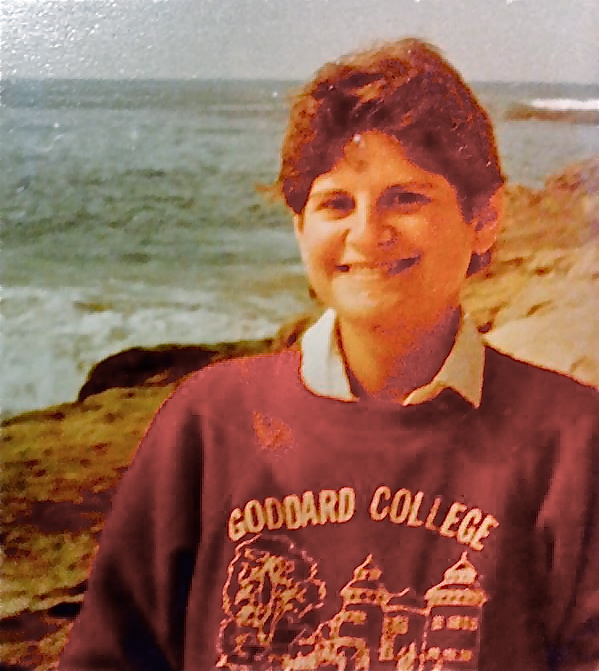
Here’s me wearing my brother Bill’s Goddard Sweatshirt in the late 1970’s. Twenty years later, I’d choose Goddard for my M.F.A in Writing Program.

May 27, 2014  Prompt #27

It’s Day Two of The Writeous Sisters’ Clothing Week.  Today’s prompt can help you ground your writing with specific, sensory details and make stronger connections between the physical and philosophical.

Inspriational Attire

The weather is warming up here in Colorado and I’m finally switching out my fleece and wool for cotton. Because I live in a small house, I store bins of off-season clothes in my garage and swap them out twice a year.  It’s become a seasonal ritual, a time to contemplate the passage of time and cycles of life. It’s also a practical opportunity to donate or recycle clothes that are worn out or that I rarely wear.  The clothes  I have the hardest time parting with, even when they are stained or frayed, are T-shirts. So many of them are associated with a specific time or place in my life.

Instructions

  1. Choose a well-loved T-shirt or sweatshirt with a logo, image, or text on it. Or, find a photo of you wearing a favorite T-shirt. Conversely, you can choose one that you dislike or feel ambivalent about but still have kept.
  2. For five minutes, write a physical and factual description of the shirt. Describe its style, color, and condition. Where, when and how did you acquire it?
  3. Next, write the psychological and emotional history of the shirt. How do you feel wearing it? Proud, hardworking, part of a team? Nostalgic or bittersweet? Do you associate the shirt with a person, place, or stage of your life?  Tell your story.

Further Writing

  • If you are currently working on a novel, consider how clothing factors into it. Do any of the characters wear T-shirts? Can you deepen characterization by including one?
  • Write about a child who outgrows a favorite T-shirt.

Variations for Writing Groups

  1. Each member brings in one or two T-shirts. You can write about the shirt you brought or someone else’s.
  2. Imagine discovering this T-shirt in a box of old beach towels after not seeing it for 10 or 20 years. Write for 20 minutes. Considerations: Is the T-shirt yours or someone else’s? Where did you last see it? How does it smell? Do you try it on?

What did you think of this writing prompt? Share your thoughts.

Go back

Your message has been sent

Warning
Warning
Warning
Warning
Warning

Warning.

A Pair of Shoes

red reeboksMay 26, 2014  Prompt #26

It’s Clothing Week here at The Writeous Sisters.  All the prompts will help you connect the physical with the abstract and delve into the story of objects everywhere.

Well-Shod

Last year, the University of Colorado’s Museum of Natural History hosted “To Feel The Earth,” an exhibit about the history and tradition of moccasins among the indigenous peoples of the American Southwest. I was moved to learn about the spiritual connection that comes from feeling  soil, rocks, and grasses through the soles of our shoes. Similarly, phrases like “walk a mile in another man’s shoes” and “boots on the ground” speak the the power and symbol of shoes.

Instructions

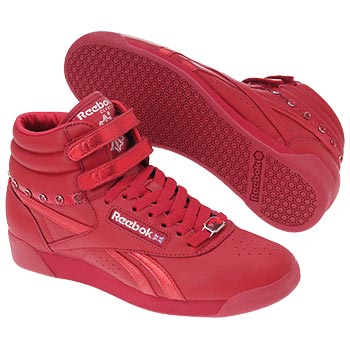
  1. Choose a pair of shoes that you currently own or that you remember vividly.
  2. For five minutes, write down the facts of these shoes. Describe their style and color. Did you buy them new? Find them a thrift store? Did someone give them to you? When did you begin wearing them? Are they worn or still look like new?
  3. Next, write their (and your) story.  How did you feel wearing them? Athletic, stylish, sexy, competent, ashamed? Do you associate a particular person, place, or stage of your life with them?  Do you polish them? Have you thread in new laces? Did you ever get them repaired? Do you still own them? Did you outgrow them or give them away?

Further Writing

  • In poetry or micro fiction, write about strapping on or lacing up for a memorable outing in the shoes. Keep your descriptions and narrative tight.
  • As today is Memorial Day, write about a pair of Army boots.

Variations for Writing Groups

  1. Each member brings in two pairs of shoes (or photos of shoes).
  2. Each member writes descriptions of people written on separate index cards. (For instance, “Ten-year old girl, raised in Chicago, visiting New Hampshire for the first time.” “Middle-aged woman returning to an office job after 10 years working at home.”  “Wyoming car mechanic, getting ready for a date, two years after his wife has died.)
  3. Match up people with shoes. Write for 20 minutes.

See the following post “Twelve Black Shoes” for my shoe story.

What did you think of this writing prompt? Share your thoughts.
Go back

Your message has been sent

Warning
Warning
Warning
Warning
Warning

Warning.

“Get in Shape” Sunday

May 25, 2014  Prompt #25

photoFor the next four Sundays, shapes will be our springboards. Today’s prompt helps you consider language more intricately and will perhaps move you to explore the origin of phrases. It encourages you to link images with people, actions or memories and build upon abstract ideas.

Ready to square off?


Instructions

  1. For five minutes, jot down associations, phrases, and images that come to mind when you hear the word “square.”
  2. Read over what you’ve written and circle a phrase or sentence that stands out for you.
  3. Write that phrase on the top of a new sheet of paper.  Write for 15 minutes.

Further Writing

  • Choose one of these phrases as your springboard: Square Meal. Square Dance. Fair and Square. Be There or Be Square. Times Square. Write for 15 minutes.
  • Find a piece of grid paper (or download one here or here.) Write on it in a non-traditional way, for instance, spiraling in or spiraling out, or writing in chunks on separate parts of the paper.

Variations for Writing Groups

  1. On individual index cards, each member writes down two phrases (one per card) with “square” in it. For example, Town Square. Square Deal. Hip to Be Square.
  2. On a second set of cards, each member writes down two short descriptions (one per card) of a person. For example, “thin man with a cigarette,” “young woman with a John Deere baseball cap,” “grandmother who just finished swimming 20 laps.”
  3. Keep the two sets of phrases in separate piles.
  4. Each member chooses one card from each pile and uses the description of the person and the “square expression” together as their prompt. For instance, the thin man takes a drag on his cigarette and says, “It’s hip to be square.”  What comes next?

What did you think of this writing prompt? Share your thoughts.
Go back

Your message has been sent

Warning
Warning
Warning
Warning
Warning

Warning.


Precipitation [Part Two]

May 24, 2014  Prompt #24

Photo


Twenty-four hours later and, again, it’s raining.

Good reason to expand on yesterday’s prompt.

If you haven’t read it already, do that first, then try these variations.


Further Writing

  • Apply personification (the assignment of human attributes to objects, abstract notions, or, in this case, weather) to a rain storm. Describe a storm, drizzle, or intermittent rain in terms of anger, generosity, fickleness or another human condition.  This option lends itself well to poetry and flash fiction. Write for 10 minutes.
  •  Write about someone waiting  rain. Describe the person’s actions without dialogue or conversation.

Variations for Writing Groups

  1. On separate index cards, each member writes down two emotions or feelings, such as frustration, joy, relief, trepidation, boredom, etc.,
  2. On a second set of cards, write down words associated with rain, such as thunder claps, puddles, windshield wipers, boots, rain jacket, flood, soaked, partly cloudy, etc.
  3. Keep the words in separate piles, face down so you can’t see the words written on them.
  4. Each member chooses one word from each pile and, from there, writes for 15 minutes. Unlikely pairings often make for the best writing, so resist the temptation to choose different words if yours seem unwieldy.

What did you think of this writing prompt? Share your thoughts.

Go back

Your message has been sent

Warning
Warning
Warning
Warning
Warning

Warning.


Precipitation

May 23, 2014  Prompt #23

PhotoLast night, I saw Venus in Fur at Denver’s Curious Theater. As an accompaniment to the show’s vigorous, changeable dialogue, the production included a thunderstorm. As I write this, back in Boulder, we’re having real live downpour, complete with rumbling thunder and flashbulb-style lightning.  All this to say: Rain is on my mind. Its tension and variability (from mist to an out-and-out thunderstorm) can enrich your writing. Yes, if mishandled, it can become a cliche, but with practice, rain (and other weather events) can skillfully drive action or accentuate tone.

Instructions

  1. Describe a light drizzle, steady downpour,  late afternoon thunderstorm, or another kind of rain. Be sure to include sensory details, such as sound and smell, as well as the setting.  (Rain in a city or desert is different than rain on a beach or against a farm house.) Write for 10 minutes.
  2. Next, write a conversation that includes either a) someone making a difficult request of someone else  or b) two or three people arguing about something minor as a way to avoid a larger issue or conflict.  Write for 10 minutes.
  3. Next (you guessed it), combine the two. Feel free to adjust the dialogue or the rain to better fit each other. Write for 15 minutes.

A Few Thoughts

  1. How does the pace, intensity, and style of rain magnify or delineate the conversation?
  2. Does the rain stop and start? How does that effect the action?
  3. How do your characters react to the rain? Do they hide under trees, shut windows, place pots and pans to collect drips?

Tomorrow: Further Writing and Variations for Writing Groups

What did you think of this writing prompt? Share your thoughts.

Go back

Your message has been sent

Warning
Warning
Warning
Warning
Warning

Warning.


This I Believe (part 2)

May 22, 2014  Prompt #22

DSCN3261


Today’s post builds on yesterday’s This I Believe prompt, offering follow-up exercises and options for writing groups. If you haven’t already read my May 21 post or listened to or read sample essays on the This I Believe website, do that now.


Further Writing

  • Choose a value or activity that is not one of your core beliefs, then write a convincing essay celebrating your deep conviction of it. I, for example, might write, “I believe in boasting.” or “I believe in the redemptive power of American Idol.” You can take on another persona as you write or write in your own voice. Write for 20 minutes.
  • Reviewing what wrote, can you see any actually core beliefs emerging from your non-beliefs? Is it freeing or unnerving to write passionately about something you are not actually passionate about?

Variations for Writing Groups

  1. Each member writes down two core beliefs (one per index card) and puts them in the middle of the table. Members randomly choose one to write about.
  2. If you are writing fiction, write a “This I Believe” essay in the voice of one of your characters.

Thoughts on this writing prompt?

Go back

Your message has been sent

Warning
Warning
Warning
Warning
Warning

Warning.


This I Believe

May 21, 2014  Prompt #21

DSCN5024Perhaps you’ve heard This I Believe essays on NPR or Bob Edwards Weekend. This I Believe is now an international organization that encourages people to write about their core values. You can read and listen to hundreds of these essays on their website.

For today’s prompt, you’ll write (or begin to write) your own “This I Believe”  essay. This exercise not only gives you the opportunity to think about the beliefs that guide you, but it also prompts you to shape your thoughts into a well-crafted work.

Instructions

  1. Go to the This I Believe website and read or listen to 2 or more essays. Click here to link to an essay I wrote ten years ago.
  2. For three minutes, free write words and phrases that come to mind when you think about what matters to you. For example,  you might write Traveling widely, Choosing kindness, Being unpredictable, or Surrounding myself with family and friends.
  3. Next, for five minutes, think about concrete examples of these core beliefs. Don’t be afraid of making odd connections; in fact, sometimes, the odder the better.  “I believe in power of balloon animals” could be the perfect lead in for writing about kindness. Or, if you believe in surrounding yourself with friends and family, consider actions that demonstrate this.  You might write, “I believe in celebrating birthdays — with 100 of my closest friends and relatives.” Or, “I believe in Family Reunions.”
  4. Finally, writing for fifteen more minutes, flesh out your ideas. Experiment, expand, and shape your story.

Notes

  • Bring together the conceptual and concrete. Use specifics to ground your essay, yet don’t be afraid to celebrate or uphold your beliefs with heartfelt or even noble language.
  • Try different tones: playful, earnest, contemplative.

Tomorrow’s Post: Suggestions for “Further Writing” and “Variations for Writing Groups.”

Thoughts on this writing prompt?

Go back

Your message has been sent

Warning
Warning
Warning
Warning
Warning

Warning.


I Don’t Remember

May 20, 2014  Prompt #20

IMG_0620 Today’s prompt turns yesterday’s “I Remember” exercise on its head.  “I Don’t Remember” motivates you to write about loss,  failure of memory, and what we repress. Use it to remember, connect, and observe.  When I’ve taught this exercise in my workshops, there’s often a lightheartedness about what our mind chooses to remember and what it forgets. Go deep, go playful, go write.


Instructions

  1. On a sheet of paper, write the phrase I don’t remember on the left side of the first line.  Skip three lines and write it again.  Repeat this until you’ve written I don’t remember twelve times. (Start a new sheet or write on the back if you need more room.)
  2. Next, fill in the blank spaces after I don’t remember with a sentence, phrase, or even a single word. For example, I don’t remember when I stopped climbing trees.  I don’t remember the last time I spoke to my brother.  I don’t remember what bus driver looked like.
  3. Work your way down the list, writing for 15 to 20 minutes.

Notes (same as yesterday’s notes.)

  • Pay attention to the sound of your words, their collective rhythm and pacing. Try varying short and long responses.
  • This exercise can create a stand-alone list poem or several spring boards for short stories, flash fiction, and narrative poems.
  • Try reading the finished piece aloud. What do you notice?

Further Writing

  • Try interspersing this sequence once or twice, I don’t remember _________, but I do remember  ______________.
  • Include specific details. Here’s one from Brainard’s book: ” I remember the only time I ever saw my mother cry. I was eating apricot pie.”

Variations for Writing Groups

  1. Choose one of your completed I don’t remember lines and expand upon it.
  2. Work in a simile. “I don’t remember why I gave away the rag wool sweater, red as the geraniums that lined our front bed, thick as the weeds that tried to choke them.

Thoughts on this writing prompt?

Go back

Your message has been sent

Warning
Warning
Warning
Warning
Warning

Warning.


I Remember

May 20, 2014  Prompt #19

DSCN6109 Introduction

Joe Brainard’s classic “I Remember” writing prompt has been taught in class rooms for more than 15 years. You can read more about Joe’s life and work and the history of the “I Remember” exercise here.  Below is a variation that has been a big hit in my writing workshops.


Instructions

  1. On a sheet of paper, write the phrase, I remember…. on the left side of the first line.  Skip three lines and write it again.  Repeat this until you’ve written I remember nine times.
  2. Skip another three lines and write I wish… then repeat two more times.
  3. Beginning at the top, fill in the blank space after I remember with a sentence, phrase, or even a single word. For example, I remember the first day of the fair.  I remember the last time I spoke to my brother.  I remember pecans. I remember darkness.
  4. Work your way down the list, writing for 15 to 20 minutes.

Notes

  • Pay attention to the sound of your words, their collective rhythm and pacing. Try varying short and long responses.
  • This exercise can create a stand-alone list poem or several spring boards for short stories, flash fiction, and narrative poems.
  • Try reading the finished piece aloud. What do you notice?

How This Prompt Can Strengthen Your Writing

  • Builds upon memory, often ushering you into a place of deeper connection.
  • Encourages experimentation and play.

Further Writing

  • Re-read your piece and circle repeating nouns or verbs that repeat. What patterns emerge?
  • Work the exercise from the perspective of someone else, either fictional or real.

Variations for Writing Groups

  1. Choose one of your completed I remember lines and expand upon it.
  2. Discuss one of the I wish lines with others in the group.

Thoughts on this writing prompt?

Go back

Your message has been sent

Warning
Warning
Warning
Warning
Warning

Warning.