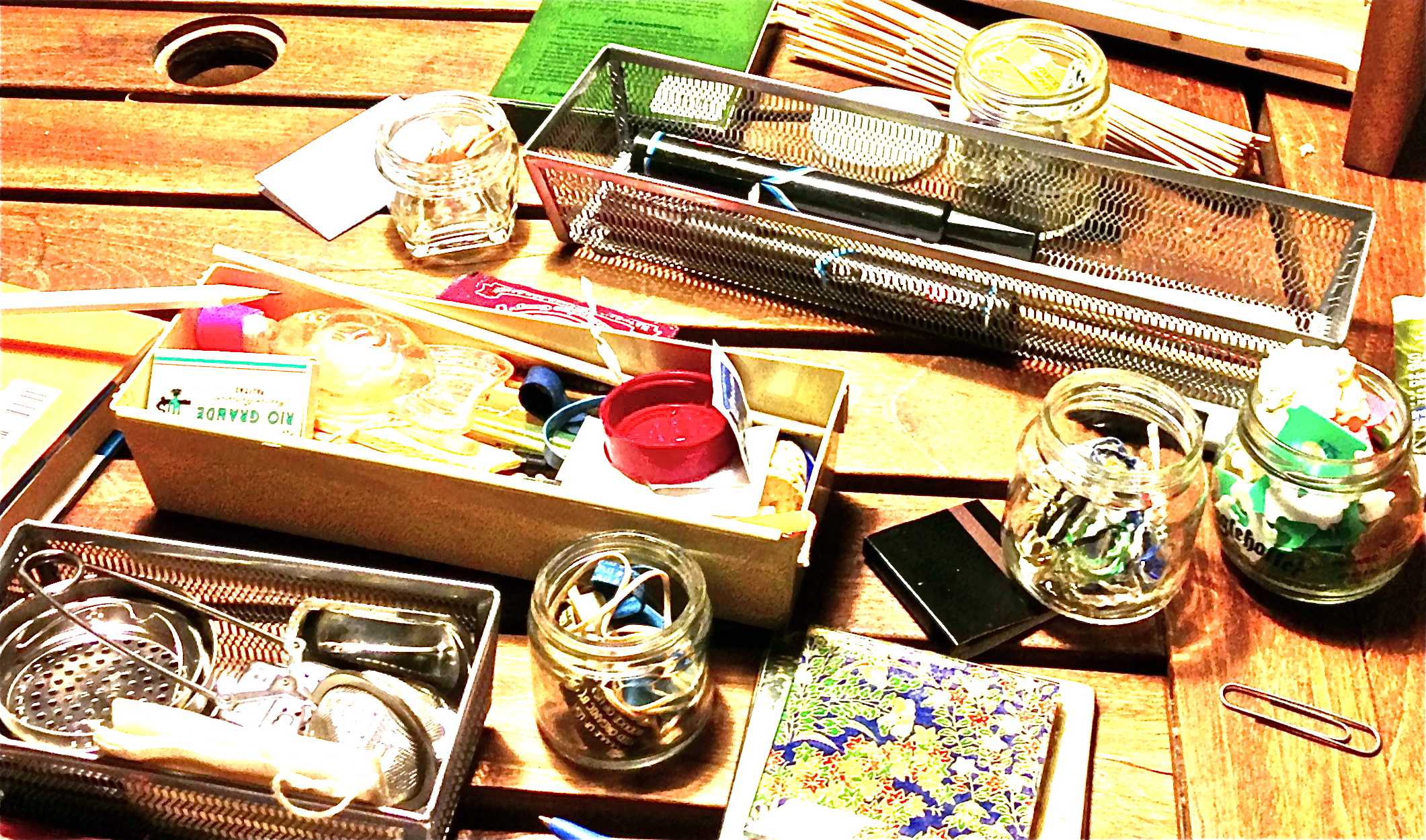
Junk Drawer

May 19, 2014  Prompt #18

IMG_0081Instructions

  1. Locate an object in your home that is generally considered ordinary, outdated, or unnecessary. Don’t spend too much time thinking about what to choose.  One option: If you have a junk drawer in your home or accumulated odds and ends at the bottom of a bag, close your eyes, reach for something, and use it.
  2. Write about this object as if it is something you value dearly. (Tell us why.) Use the word “surprise” once in your writing. Write for 10 minutes.
  3. Write about the same object as if it is something you no longer want, but cannot give away. (Tell us why.) Use the word “regret” once in your writing. Write for 10 minutes.

How This Prompt Can Strengthen Your Writing

  • Encourages you to look at an ordinary object in a fresh way.
  • Encourages imagination and perhaps playfulness.

Further Writing

  • Imagine someone else holding this object. What would surprise them?
  • Write as if a family member asked for this object. Why do they want it? Do you relent?

Variations for Writing Groups

  1. Ask each member to bring in one or two objects. Use them as your springboards.
  2. Write as if you discovered the object in a trunk of old table clothes in your attic or basement. You know it belongs to another family member. Write a letter to that person to accompany the returned item.

Thoughts on this writing prompt?

Go back

Your message has been sent

Warning
Warning
Warning
Warning
Warning

Warning.


Sensory Weekend: Rolling Up Your Sleeves

May 18, 2014  Prompt #17

urban-wall-crack-remove


Today features a short prompt: less background, no further writing or writing group variations. Enjoy getting your hands dirty.


Instructions

Describe an action below. Include at least four different senses.  Write for 15 minutes.

  • Digging a hole.
  • Shucking six ears of corn.
  • Plastering cracks in a wall.
  • Building a ceramic vase out of clay.
  • Handwashing a wool sweater in a tub of water.


What did you think of this writing prompt? Share your thoughts.

Go back

Your message has been sent

Warning
Warning
Warning
Warning
Warning

Warning.


Sensory Weekend: Smokin’

May 17, 2014  Prompt #16

cigar smoke


Today and tomorrow feature short prompts: less background, no writing group variations. Have a good weekend!


Surgeon General’s Warning

If you are not a smoker, don’t light up to complete this exercise. Work from memory or sit near smokers and take notes.

Instructions

    1. Write for 10 minutes about tobacco (cigarette, cigar or pipe) smoke, either first- or second-hand. Consider how it smells, tastes, and looks.
    2. Write down six adjectives and six verbs that describe smoke or your experience of it. Integrate some of these words into your piece. Write for 10 more minutes.

Further Writing

    1. Write about entering a room that smells of cigar smoke.
    2. Write about someone blowing smoke rings.

What did you think of this writing prompt? Share your thoughts.

Go back

Your message has been sent

Warning
Warning
Warning
Warning
Warning

Warning.


Sensory Week: Taste

May 16, 2014  Prompt #15

orangesTo wrap up Sensory Week, it’s our long-awaited taste prompt. To enrich this exercise, I’ve included other senses as well.  Tuck a napkin under your chin and let’s get started.


Instructions

  1. Choose a fruit that you enjoy (or dislike) for this exercise. Other foods can work too; you may need to adjust the instructions. Follow the steps below, noting experiences, associations, and responses.
  2. Hold the fruit in your hand. Briefly describe its weight and texture.
  3. Smell the fruit. Does your mouth start watering? Puckering?
  4. Peel the fruit, stopping frequently to describe the experience, noting memories and questions that arise. If the fruit isn’t peel-able, skip this step or slice the fruit instead.
  5. Touch the fruit to your tongue. First impressions?
  6. Section or slice the fruit if needed, then take a small bite.  How do your tongue, lips, and mouth react? Describe the experience.
  7. Continue eating. Continue writing.

How This Prompt Can Strengthen Your Writing

  • Encourages you to write slowly and thoughtfully, since several steps are involved.
  • Helps you bring sensory details into your work.
  • Encourages association and memory recall.

Further Writing

  • Imagine a person eating this fruit for the first time. What would surprise them?
  • Describe how different people might approach eating a pineapple, pear, or banana. How does how they eat reflect who they are?

Variations for Writing Groups

  1. If the season is right (usually late summer or fall in the U.S.), try tasting and describing three different apple varieties.
  2. If available, compare, and describe eating an orange, tangerine, and blood orange. Or a standard lemon and a Meyer lemon. Or a grapefruit, orange, lemon, and lime. What do these different fruits conjure up for you?
  3. If available, try a fruit that is new to you. Some fruits I hadn’t eaten as a child include a star fruit (or carambola), horned melon (or kiwano), and even a fresh fig.

What did you think of this writing prompt? Share your thoughts.

Go back

Your message has been sent

Warning
Warning
Warning
Warning
Warning

Warning.


Creating Atmosphere

May 10, 2014  Prompt #9

IMG_0983Here’s one of my favorite kids/science nerd jokes:

Q. Why did the restaurant on the moon go out of business?
A. Because it had no atmosphere!

Like a good restaurant, good writing needs atmosphere, which I loosely define as the mood, tone, or feel of the piece. What contributes to a work’s atmosphere? At least four elements (I’m sure there are more) including word choice, writing style, details and, what we’ll focus on here, setting.

Imagine, for instance, the same conversation in a noisy Chicago diner, a near-empty, small-town Laundromat, or inside a rattling blue truck on a foggy rural road. How would these different settings reinforce the conversation or play counterpoint to it?

Instructions 

For this two-part writing exercise (more tomorrow), choose a location from the first list and a quality of light from the second list. If none of these choices inspire you, make up your own.

Location: kitchen • basement • attic • bedroom • den • sun room • living room • baby’s room • patio • driveway • hallway • laundry room

Quality of Light: dim • dusk • dark • filtered • blazing sun • gloomy • warm • cold • dawn • partly cloudy • glaring

With your location and quality of light chosen (for instance, dawn on the driveway), write your phrase on a fresh piece of paper. Write for 10 minutes, setting the physical scene.

Tips for Creating a Memorable Setting

  1. Include specifics. Is a car parked on the driveway? Does a child’s bike lie on its side? Has a recent rain washed away half a chalk drawing? Is there a long crack in the drive, always meant to be repaired?
  2. Include sensory details. What color is the sky? Is the driveway  cool or hot? Do blooming lilacs scent the air? Or is it the smell of garage, not picked up for weeks.
  3. How does your location and quality of light work together to set the tone?
  4. Don’t include characters, actions or dialogue yet. Focus on the setting the mood.

How This Prompt Can Strengthen Your Writing

  • Encourages you to observe and imagine as you combine elements.
  • Creating a strong setting adds complexity and layers to your writing.

Further Writing and Considerations

  1. Choose a different location and quality of light.
  2. Choose the same location, but a different quality of light.
  3. Choose the same quality of light, but a different location.
  4. Does the style of your writing change depending upon the setting your choose?

Variations for Writing Groups

  1. On index cards, each member writes down a location and kind of light. Or choose another variable, such as time of day, season, or weather. (Just don’t start with “It was a dark and stormy night.”)
  2. Put the index cards in two piles.
  3. Each member chooses one card from each pile and writes for 15 minutes.
  4. If possible, have members share their work. Listen for a sentence or phrase that impressed or puzzled you. Write it on the top of a fresh sheet of paper.
  5. Write in response to it for 15 more minutes.

What If?

blue maps

May 2, 2014  •  Exercise #1

This first exercise gives you a series or words and phrases to work with. I suggest printing the text below on a sheet of lined paper or typing it onto a fresh electronic page. Once you’ve finished that, start your 10-minute times and fill in the blanks with a short sentence, phrase, or single word.

If you are working on fiction, you can write from the point of view of one of your characters. If you are working on memoir, you can write in your own voice at any age. If you are writing poetry, this structure make lend itself well to list poem.

A few tips: Write quickly.  Don’t over-think. If you are stuck, move on. (Remember, this won’t be graded!) Experiment. Break the mold or build on it. (More on that later.)  Write for ten minutes.


How This Prompt Can Strengthen Your Writing

  1. The word “if” invites you to consider possibilities and gives you permission to dream.
  2. The fill-in-the-blank format encourages brevity and the strengths that come with it.
  3. It can help you build rhythm into your writing.

IF

If I were ____________________________________________________________________
I would _____________________________________________________________________

If I were _____________________________________________________________________
I would not  ___________________________________________________________________

What if I _____________________________________________________________________
What if you____________________________________________________________________

What if I _____________________________________________________________________
What if  you___________________________________________________________________
What if we ____________________________________________________________________

If  instead ______________________________________________________________________

If instead ______________________________________________________________________

What if ________________________________________________________________________

If you hadn’t ____________________________________________________________________
I would ________________________________________________________________________

If I hadn’t ______________________________________________________________________
you would [not] ___________________________________________________________________

If only _________________________________________________________________________
If only_________________________________________________________________________

If  ____________________________________________________________________________

If_____________________________________________________________________________

Next Steps

Was ten minutes enough time?  Did you keep going? If you felt engaged with this exercise, here are two follow-ups:

  • Choose one sentence or phrase from the set and expand it on it. Turn it into a full paragraph, a narrative poem, or a flash fiction piece.
  • Read what you have written out loud. Can you hear a rhythm or pattern in your words? Does a word or phrase feel out of place or less lyrical?  If so, try writing it another way.

Tips for Writing Groups

  • Read your work out loud to see how others worked with the prompt. Do any of their approaches inspire you?
  • As a next step, choose a phrase or sentence from one of your group members and write it on the top of new sheet of paper. Then write for 10 to 20 more minutes in response to it. After, if you feel so inclined, share your work again.